


Scientific Context
Distinguish published research findings from claims about a specific product.
AURATIDE | LABORATORY RESEARCH MATERIALS
Explore research materials, product specifications, and available documentation.
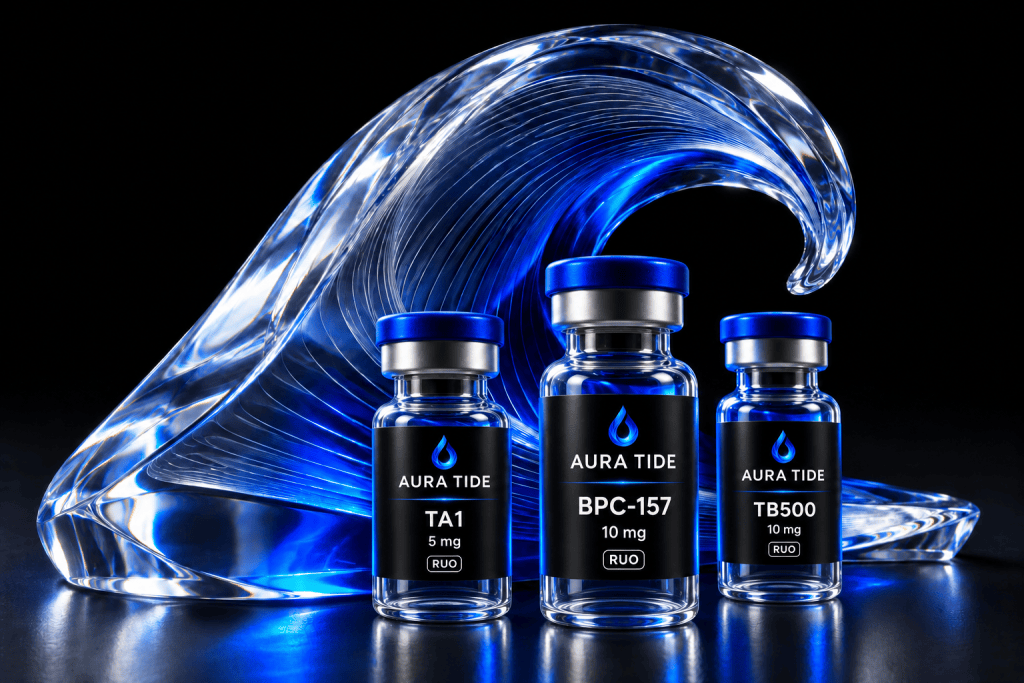
FEATURED RESEARCH MATERIALS
Browse product specifications, available formats, and supporting documentation.
HELP & INFORMATION
Find answers to common catalog and documentation questions.
AuraTide materials are intended exclusively for laboratory research. They are not for human or animal use.
Check each product page for the listed identity, quantity, supplied format, and available documentation. Contact AuraTide if a required detail is missing.
Visit the COA page and match the product identity and batch or lot number. If the matching report is unavailable, contact AuraTide before relying on another batch’s report.
Review the shipping policy for published delivery areas, processing information, and shipping terms. Contact AuraTide if your question is not covered.
Read the refund policy before ordering. For order-specific questions, contact AuraTide through the contact page.
No. These materials are for laboratory research only. AuraTide does not provide instructions for human or animal use.
CONTACT AURATIDE
Have a question about the catalog, product specifications, or available documentation? Contact AuraTide with the product name and relevant batch or order details so we can review your inquiry.
RESEARCH LIBRARY
Evaluate research context through cited sources, clear product specifications, and relevant analytical records.
Distinguish published research findings from claims about a specific product.
Match product identity and batch details before relying on an analytical report.
Review the listed quantity, supplied format, and available material documentation.
RESEARCH LIBRARY
Peptide research begins with a sequence of amino acids. Understanding that sequence—and how a material is produced and characterized—is part of understanding the science.
A 2022 peer-reviewed review by Wang and colleagues examines peptide discovery, production, and modification.
The review describes chemical and biological production methods. One established approach, solid-phase peptide synthesis, builds a peptide through repeated steps that join amino acids together.
Synthesis can produce unwanted side products. The authors discuss purification and analytical technologies as important parts of peptide development. A product name alone does not describe its analytical characteristics.
Peptide sequence and structure influence molecular properties. The review also discusses stability challenges, helping explain why researchers investigate modifications and carefully defined experimental conditions.
Wang, L., Wang, N., Zhang, W., et al. (2022). Therapeutic peptides: current applications and future directions. Signal Transduction and Targeted Therapy, 7, 48.
Read the Original Review ↗This educational summary does not establish the quality, safety, or suitability of any AuraTide product. Materials are for laboratory research only, not for human or animal use.